QUICK ANSWER
What matters first.
Choose one geographic focus—Lake Kawaguchiko, Hakone or a climbing-season objective. Avoid itineraries that promise too many distant stops in one winter day.
- Choose one geographic focus—Lake Kawaguchiko, Hakone or a climbing-season objective. Avoid itineraries that promise too many distant stops in one winter day.
- Choose the right Tokyo base
- Compare current airport transfer options
- Choose between Fuji by car, train or tour
EDITORIAL DECISION
The choice, before the detail.
Travellers who want one realistic day out with a clear route and an honest stopping point.
You want to cover every secondary sight or strongly dislike an early start.
Check the day’s first and last connections, weather and any reserved segment before leaving.
Choose a good
Mount Fuji tour

See live departure dates and today's total before the popular slots go.
CHECK LIVE PRICECHECK TOUR PRICE · Check the current Mount Fuji day tour with our travel partner ↗A good Fuji tour protects the transport plan while leaving enough flexibility for weather and visibility.
TL;DR: Choose one geographic focus—Lake Kawaguchiko, Hakone or a climbing-season objective. Avoid itineraries that promise too many distant stops in one winter day.
01Compare route shapes
- Best for
- Classic lake views
- Check
- Number and length of stops
- Best for
- Varied transport and scenery
- Check
- Long road time
- Best for
- Flexible pacing
- Check
- Complete vehicle price
| Tour shape | Best for | Check |
|---|---|---|
| Kawaguchiko and Oshino | Classic lake views | Number and length of stops |
| Hakone and Lake Ashi | Varied transport and scenery | Long road time |
| Small group / private | Flexible pacing | Complete vehicle price |
02Best next booking
Once the route is clear, book the next item that makes the day trip easier to execute from Tokyo.
- Choose the right Tokyo base
- Compare current airport transfer options
- Choose between Fuji by car, train or tour
03Weather is part of the product
No operator can guarantee a clear view. Read the cancellation policy, but assume an ordinary departure continues when the mountain is clouded. A strong itinerary should still offer a worthwhile lake, village or museum day.
04Read the meeting details
Check the exact Tokyo meeting point, language, vehicle size, included admissions, meal plan and return location. Do not schedule a fixed dinner immediately after the advertised return time.
05The season decides more than the operator
Most disappointment with Fuji tours comes from booking the right tour in the wrong month.
Winter, roughly December to February, is the best time to actually see the mountain. Cold, dry air gives the clearest and most frequent views of the year. The trade-off is that some higher roads and seasonal attractions close, and daylight is short.
Summer, roughly June to August, is the worst time for views despite being peak travel season. Humidity and cloud mean the mountain is often invisible from the lakes even on a fine day. It is, however, the only period when the climbing trails and the 5th Station are reliably open.
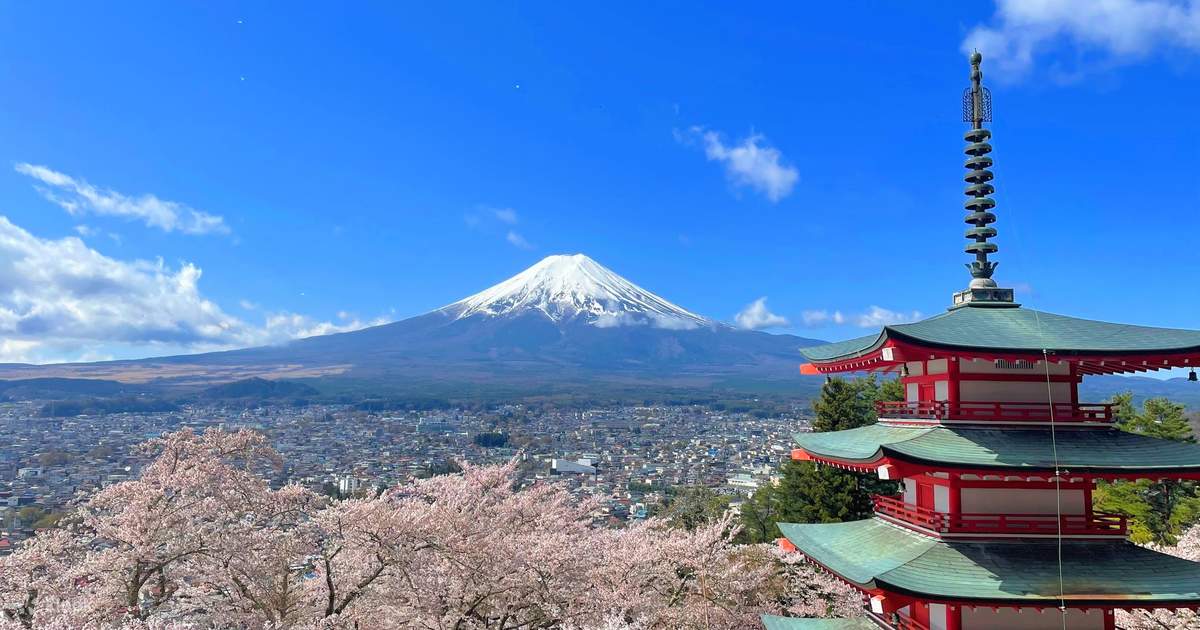
Spring and autumn sit in between, and carry the added draw of cherry blossom at Chureito Pagoda or autumn colour around the lakes — both of which produce crowds heavy enough to slow a coach itinerary noticeably.
If a clear view matters more than anything else, go in winter and accept the shorter day. If you are travelling in July or August, book the tour for the stops rather than the mountain, and treat any view as a bonus.
06Check what "Fuji" means on the itinerary
Tours use the name loosely, and the differences are large.
- The 5th Station is partway up the mountain, reached by road, and is closed by snow for much of the year. Being there means you cannot see Fuji, because you are on it.
- Lake Kawaguchiko gives the classic reflected view and is open year-round.
- Oshino Hakkai is a small spring-water village, pretty and very crowded in season.
- Chureito Pagoda is the pagoda-and-mountain photograph, and involves around 400 steps.
- Hakone is a separate region entirely, with distant Fuji views on a good day rather than close ones.
An itinerary listing four of these plus Gotemba outlets in one day is selling you the coach, not the mountain.
Official regional context: Fuji Five Lakes tourism.
07FAQ
Can a Mount Fuji tour guarantee a view?
No. Visibility changes quickly and is never guaranteed.
Is Hakone the same as the Fuji Five Lakes?
No. They are different areas roughly an hour apart, and Hakone offers distant Fuji views rather than close ones. Combining both in a single day trip from Tokyo produces a lot of road time.
When is the best time of year to see Mount Fuji?
Winter, roughly December to February. Cold dry air gives the clearest and most frequent views. Summer is the worst season for visibility even though it is peak travel time, because humidity and cloud often hide the mountain completely.
Does a tour to the 5th Station mean I will see Fuji?
Not in the way most people picture. The 5th Station is on the mountain, so you get the view outward rather than the postcard view of the peak. It is also closed by snow for much of the year.
How many stops should a one-day Fuji tour have?
Three or four is realistic. An itinerary promising Kawaguchiko, Oshino Hakkai, Chureito Pagoda, the 5th Station and an outlet mall in one day is selling coach time rather than the mountain.