QUICK ANSWER
What matters first.
Ask your hotel to send luggage to the next staffed hotel one or two days ahead. Keep medicine, documents, valuables and one change of clothes with you. For a few hours, use station lockers or staffed baggage storage instead.
- Ask your hotel to send luggage to the next staffed hotel one or two days ahead. Keep medicine, documents, valuables and one change of clothes with you. For a few hours, use station lockers or staffed baggage storage instead.
EDITORIAL DECISION
The choice, before the detail.
First-time visitors who want a practical setup before arrival and fewer decisions on day one.
You already have a working Japan-specific setup and only need a live official rule.
Verify time-sensitive rules with the named operator or authority immediately before relying on them.
Send the
suitcase ahead

Compare the real transfer total before late-night options tighten.
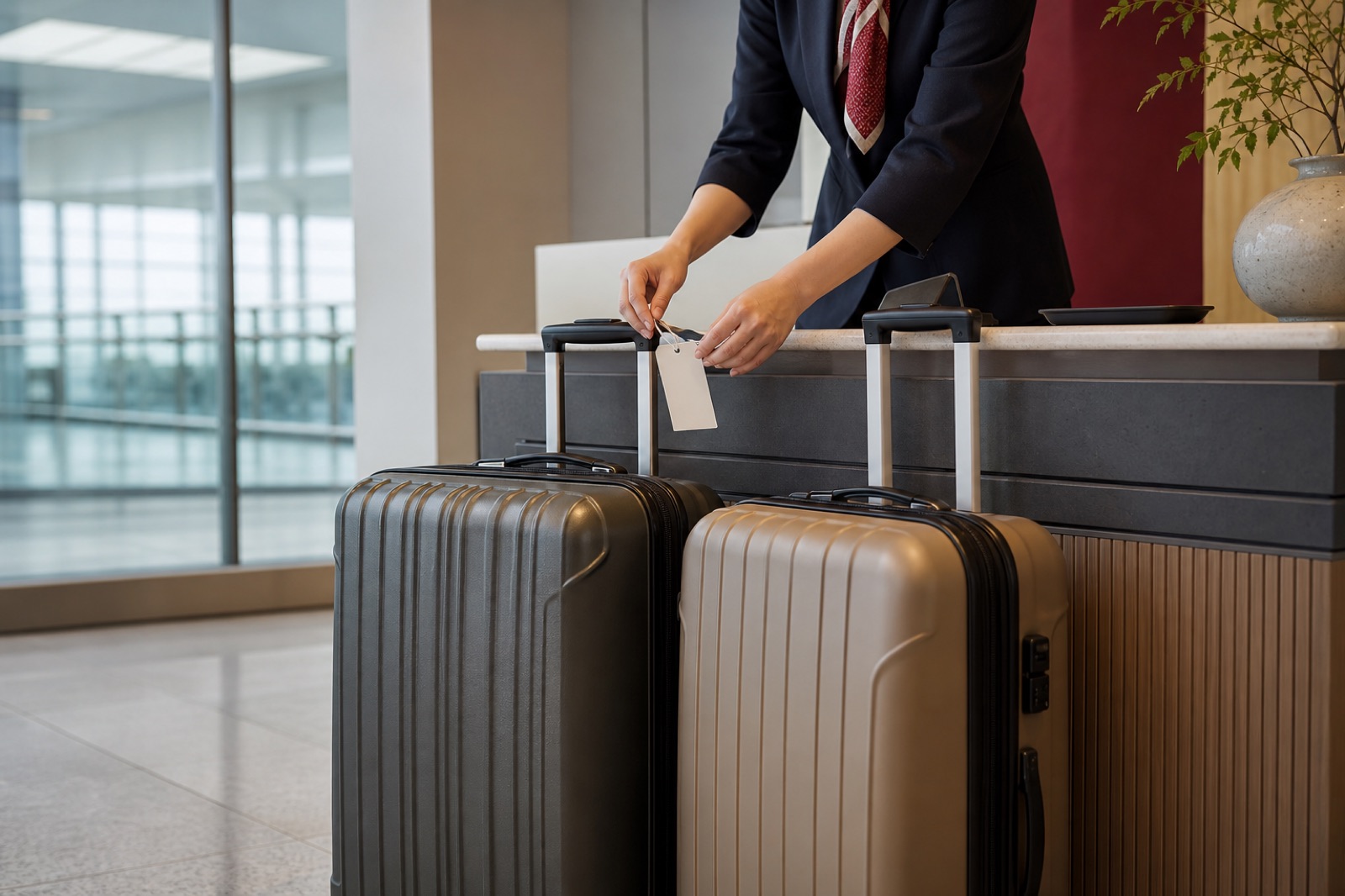
CHECK LIVE PRICECHECK TRANSFER PRICE · Check Tokyo airport luggage-delivery options ↗Japan’s luggage forwarding services can turn a difficult transfer into a normal sightseeing day. Send the large suitcase ahead, keep one overnight bag, and move through stations without wrestling with stairs or crowded trains.
TL;DR: Ask your hotel to send luggage to the next staffed hotel one or two days ahead. Keep medicine, documents, valuables and one change of clothes with you. For a few hours, use station lockers or staffed baggage storage instead.
01Delivery, storage or locker?
- Best tool
- Luggage forwarding
- Typical timing
- Often next day; longer for remote areas
- Best tool
- Airport delivery counter
- Typical timing
- Same day or next day, depending on cutoff
- Best tool
- Coin locker
- Typical timing
- Same day
- Best tool
- Staffed baggage counter
- Typical timing
- Same day
| Need | Best tool | Typical timing |
|---|---|---|
| Hotel to hotel | Luggage forwarding | Often next day; longer for remote areas |
| Airport to hotel | Airport delivery counter | Same day or next day, depending on cutoff |
| A few sightseeing hours | Coin locker | Same day |
| Oversize bag or full lockers | Staffed baggage counter | Same day |
The best-known forwarding service is often called takkyubin or takuhaibin. Hotels, convenience stores and dedicated counters can accept luggage, but not every small accommodation provides the service.
02How hotel-to-hotel forwarding works
- Confirm that the next accommodation accepts forwarded luggage and note the reservation name.
- Ask the front desk about the required delivery lead time.
- Write the destination address, phone number and arrival date on the shipping form.
- Pay the fee and keep the receipt and tracking number.
- Carry an overnight kit in case delivery takes longer than planned.
Remote islands, ski areas and holiday periods need extra time. Send bags earlier before flights or cruises; never rely on a last-minute delivery for something you must check in.
03A practical airport luggage-delivery option
If your first day includes a long transfer or same-day sightseeing, compare a pre-booked airport luggage service with station lockers and taxi fares. It is most useful when you land in Tokyo, cannot check in yet and do not want to carry a full suitcase through rail changes.
04What never goes in the forwarded bag
Keep passports, cash, payment cards, medication, fragile electronics, keys and irreplaceable items with you. Airlines and delivery companies have separate restrictions on batteries, aerosols and hazardous materials.
Photograph the bag and luggage tag before handing it over. Use a recognizable strap, but do not leave passport details visible on the outside.
05Coin lockers without the confusion
Lockers cluster near station gates, but a large station may have many separate locker zones. Photograph the locker number and nearest exit. Some accept coins, some transport IC cards and some QR or code payment.
If you use an IC card, the same card becomes the key—do not spend its balance down to zero or confuse it with a companion’s card. Storage time and overnight surcharges vary. Lockers are not a substitute for long-term storage.
06Shinkansen and large luggage
On some Tokaido, Sanyo and Kyushu Shinkansen services, oversized baggage requires a seat with an oversized-baggage area reservation. Very large items may not be accepted. Check dimensions before travel and reserve the correct seat; forwarding is often easier.
Ordinary suitcases should not block aisles, door areas or wheelchair spaces. Overhead racks suit smaller cases, while designated spaces have specific rules.
07A practical two-night strategy
For a Tokyo–Hakone–Kyoto sequence, send the large bag from Tokyo to Kyoto, pack one night for Hakone, and travel with a small bag. This removes the suitcase from mountain buses and lets you start sightseeing in Kyoto before hotel check-in.
08FAQ
Will my suitcase arrive the same day?
Sometimes on airport or local routes, but hotel-to-hotel delivery is commonly planned for the next day or later. Confirm the cutoff and destination.
Can a vacation rental receive luggage?
Only if a person is available to accept it and the host confirms. A staffed hotel or service counter is safer.
What if station lockers are full?
Try another gate area or use a staffed baggage-storage counter; large hubs often have several zones.