QUICK ANSWER
What matters first.
Take the Nozomi unless you hold a JR Pass. Tokyo to Kyoto is about 2 hours 15 minutes on the Nozomi and roughly ¥14,000 for a reserved seat. JR Pass holders should take the Hikari instead, which covers the same route in about 2 hours 40 minutes and needs no supplement. Book seat **E on the right-hand side** for Mt Fuji, and reserve space in advance if any bag is larger than 160cm in total dimensions — that rule is the one that catches visitors out.
- Take the Nozomi unless you hold a JR Pass. Tokyo to Kyoto is about 2 hours 15 minutes on the Nozomi and roughly ¥14,000 for a reserved seat. JR Pass holders should take the Hikari instead, which covers the same route in about 2 hours 40 minutes and needs no supplement. Book seat E on the right-hand side for Mt Fuji, and reserve space in advance if any bag is larger than 160cm in total dimensions — that rule is the one that catches visitors out.
- Unreserved (jiyuseki): around ¥550 cheaper. Fine on a weekday morning, a gamble on a Friday evening or during Golden Week and Obon.
- Reserved (shiteiseki): the default recommendation. Costs little more and removes the entire problem.
- Green Car: roughly ¥19,000. Wider seats, quieter carriage. Worth it if you are tall or travelling at a peak hour; otherwise ordinary reserved is perfectly comfortable.
EDITORIAL DECISION
The choice, before the detail.
Independent travellers comparing total time, cost and transfers rather than one headline fare.
You prefer a fully arranged route and do not want to compare operating conditions.
Recheck live schedules, luggage rules, licence requirements and the final dated price before travel.
Tokyo to
Kyoto, sorted

Check today's dated ticket price and bundle value before you commit.
SEE CURRENT FARESCHECK TICKET PRICE · Compare Tokaido Shinkansen tickets ↗Reviewed 31 July 2026 · Fares, timetables and baggage rules change. Confirm with JR Central before travel. Some links are affiliate links; recommendations are chosen for relevance, not commission.
TL;DR — Take the Nozomi unless you hold a JR Pass. Tokyo to Kyoto is about 2 hours 15 minutes on the Nozomi and roughly ¥14,000 for a reserved seat. JR Pass holders should take the Hikari instead, which covers the same route in about 2 hours 40 minutes and needs no supplement. Book seat E on the right-hand side for Mt Fuji, and reserve space in advance if any bag is larger than 160cm in total dimensions — that rule is the one that catches visitors out.
01Which shinkansen goes from Tokyo to Kyoto?
Three services run the Tokaido line, and they differ only in how many stations they skip.
| Train | Tokyo → Kyoto | Stops | Covered by JR Pass? |
|---|---|---|---|
| Nozomi | ~2h 15m | Fewest | Only with a paid supplement |
| Hikari | ~2h 40m | A few more | Yes, fully |
| Kodama | ~3h 50m | Every station | Yes, fully |
The Nozomi leaves Tokyo Station several times an hour and is the default for anyone paying cash. The 25-minute penalty for taking a Hikari instead is small, so JR Pass holders lose very little.
Kodama exists for stops between the two cities. It is not a sensible way to reach Kyoto unless you are deliberately breaking the journey.
Is the JR Pass worth buying for this trip alone?
No. A Tokyo–Kyoto round trip costs roughly ¥28,000 against ¥50,000 for a 7-day pass. The pass only makes sense once you add a third distant city — the arithmetic is in our JR Pass guide.
02What does it cost?
A one-way reserved seat in an ordinary car runs about ¥14,000, made up of a base fare plus a limited-express charge. Prices shift slightly by season and by train type.
- Unreserved (jiyuseki): around ¥550 cheaper. Fine on a weekday morning, a gamble on a Friday evening or during Golden Week and Obon.
- Reserved (shiteiseki): the default recommendation. Costs little more and removes the entire problem.
- Green Car: roughly ¥19,000. Wider seats, quieter carriage. Worth it if you are tall or travelling at a peak hour; otherwise ordinary reserved is perfectly comfortable.
There is no meaningful discount for booking early on the shinkansen. Prices are essentially fixed, so there is no advantage to committing months ahead — only to reserving a seat once your date is firm.
03How do you buy a ticket?
Four routes, in rough order of how easy they are for a visitor.
- Online with SmartEX. The English-language app and site for the Tokaido line accepts foreign credit cards, lets you choose your seat on a map, and links the booking to an IC card so you tap straight through the gate. This is the smoothest option and the one worth setting up before you fly.
- Ticket machines at the station. Green machines have an English mode and take cards. Fast once you know which train you want.
- A JR ticket office (midori-no-madoguchi). Slower and often queued, but the right choice for complicated itineraries or if something has gone wrong.
- A reseller before you travel. Useful if you want the purchase settled before arrival.
If you hold a JR Pass, reservations are free — make them at a machine or ticket office rather than just boarding, especially on Friday and Sunday evenings.
04The luggage rule that catches people out
This is the single most useful thing to know before boarding.
On the Tokaido shinkansen, any bag whose combined height, width and depth exceeds 160cm requires a free advance reservation for an oversized-baggage seat, which sits in front of the luggage space at the rear of the carriage. Turning up without one means a ¥1,000 charge and being directed to wherever staff can fit the bag.
For most travellers this means: a normal carry-on is fine, and a large checked suitcase probably is not. Measure before you book — 160cm total is smaller than it sounds, and a 28-inch case usually exceeds it.
Bags over 250cm total are not permitted at all and must be forwarded separately.
The alternative worth considering is luggage forwarding. Sending the large case ahead to your Kyoto hotel typically costs around ¥2,000–3,000 per bag, arrives next day, and turns the shinkansen leg into an easy ride with a day bag. On a Tokyo–Kyoto move with big suitcases, this is often the better answer than fighting for baggage space.
→ How luggage delivery and coin lockers work in Japan
05Which side for Mt Fuji?
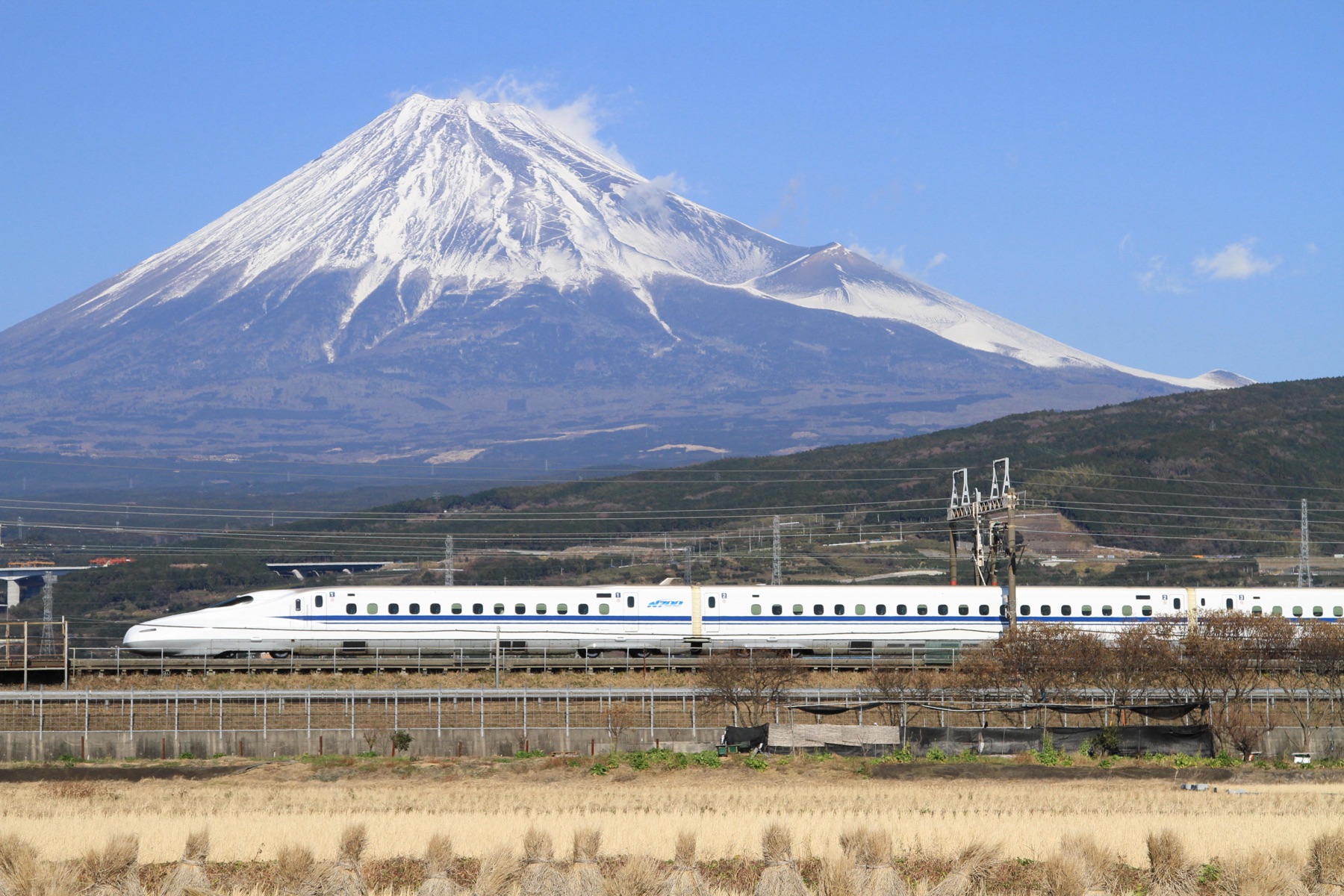
Seat E, on the right-hand side, travelling from Tokyo to Kyoto. In ordinary cars, seats run A–B–C on one side and D–E on the other; E is the window seat on the Fuji side heading west.
The mountain appears roughly 40–45 minutes out of Tokyo, around Shin-Fuji station, and stays in view for several minutes. Coming back the other way, you want seat A.
Two honest caveats. Fuji is hidden by cloud a large share of the time, most often in summer — winter and early morning give the best odds. And the view is brief, so keep the camera ready rather than watching for the whole hour.
If Fuji is genuinely important to the trip, do not rely on the train for it. Hakone gives you hours of it rather than minutes.
06Practical notes for the ride
Trains leave exactly on time; the platform display shows where each carriage will stop, and queues form on those marks. Arriving ten minutes early is plenty.
There is no longer an onboard trolley service on the Tokaido shinkansen, so buy food before boarding. Tokyo Station's ekiben (station bento) selection is genuinely worth the detour — it is part of the experience rather than a fallback.
Every seat row has power outlets in the newer sets, luggage racks overhead take carry-on size easily, and reclining is normal and uncontroversial. Phone calls are taken in the vestibule between carriages, not at the seat.
07Kyoto Station, and getting to your hotel
The shinkansen arrives at Kyoto Station, which is south of the city centre. That matters: many of Kyoto's best-known districts are a further 15–25 minutes away by bus, subway or taxi.
If your hotel is in Gion or the eastern hills, factor that final leg into the plan rather than assuming arrival at Kyoto Station means arrival at your hotel.
→ Kyoto Station or Gion: where to stay · Best hotels near Kyoto Station
One timing note: seats sell out fastest in the last three weeks of November, when Kyoto is at peak autumn colour and the whole country is moving. The foliage forecast shows which weeks those are.
08Does the same advice work from Kyoto to Tokyo?
Almost all of it. The return leg runs on the same line with the same trains, so the journey time is unchanged at about 2 hours 15 minutes on the Nozomi, and the fare is the same roughly ¥14,000 for a reserved ordinary seat. Nozomi still beats Hikari on speed, and JR Pass holders still need to take the Hikari.
Two things do change.
The Mt Fuji window swaps sides. Seat E is still the Fuji seat going in either direction, because the seat letters are fixed to the carriage rather than to the direction of travel. Heading to Kyoto it sits on your right; heading back to Tokyo the same seat is on your left. Book E either way and ignore whether it feels like the "wrong" side.
Your arrival station is a choice. Trains from Kyoto stop at Shinagawa before Tokyo Station, and Shinagawa is often the better place to get off — it is closer to the south and west of the city, and it connects straight to Haneda. If your hotel is nearer Shinagawa, staying on to Tokyo Station adds time for nothing.
Departing from Kyoto Station is otherwise simpler than departing Tokyo: the shinkansen gates are concentrated on the south side of the building, and the station is far smaller than Tokyo's. Give yourself twenty minutes if you are collecting reserved tickets from a machine.
09Tokyo to Kyoto FAQ
How long does the shinkansen take from Tokyo to Kyoto?
About 2 hours 15 minutes on the Nozomi, 2 hours 40 minutes on the Hikari and roughly 3 hours 50 minutes on the all-stops Kodama.
How much is the shinkansen from Tokyo to Kyoto?
Around ¥14,000 for a one-way reserved seat in an ordinary car. Unreserved saves roughly ¥550; the Green Car costs about ¥19,000.
Can I use the JR Pass on the Nozomi?
Only by paying a supplement. Hikari and Kodama are fully covered and run the same route, so most pass holders simply take the Hikari and accept 25 extra minutes.
Do I need to reserve a seat?
Not strictly — unreserved cars exist. Reserve anyway on weekends, holidays, Golden Week, Obon and any evening departure. The cost difference is small and standing for two hours with luggage is not.
Which side of the shinkansen has the Mt Fuji view?
The right-hand side going Tokyo to Kyoto, which is seat E. Going back toward Tokyo, sit on the right again — that is seat A.
Can I take a large suitcase on the shinkansen?
Bags up to 160cm total dimensions need no reservation. Between 160cm and 250cm you must reserve an oversized-baggage seat in advance or pay ¥1,000 on board. Over 250cm is not allowed; forward it instead.
Is it better to fly from Tokyo to Kyoto?
No. Kyoto has no airport, so flying means Osaka plus a transfer, which erases the time saving on a city-centre-to-city-centre basis. Flying only starts to win further west — see domestic flights versus the shinkansen.
Where do I buy shinkansen tickets as a foreign visitor?
SmartEX is the easiest: English, foreign cards accepted, seat selection, and it links to an IC card for gate entry. Station machines and JR ticket offices both work too.