QUICK ANSWER
What matters first.
The date decides this, not the scenery. Nikko peaks in mid to late October; Hakone peaks around mid November. If you are in Japan in October, Nikko is the answer and Hakone will still be green. If you arrive in mid November, Hakone is at its best and Nikko has already dropped its leaves. Only in the first days of November do both work, and then Hakone wins on ease.
- The date decides this, not the scenery. Nikko peaks in mid to late October; Hakone peaks around mid November. If you are in Japan in October, Nikko is the answer and Hakone will still be green. If you arrive in mid November, Hakone is at its best and Nikko has already dropped its leaves. Only in the first days of November do both work, and then Hakone wins on ease.
EDITORIAL DECISION
The choice, before the detail.
Travellers who want one realistic day out with a clear route and an honest stopping point.
You want to cover every secondary sight or strongly dislike an early start.
Check the day’s first and last connections, weather and any reserved segment before leaving.
Nikko
or Hakone in autumn
Check today's dated ticket price and bundle value before you commit.
FROM US$45.75CHECK TICKET PRICE · Check the current Hakone Freepass price ↗Reviewed 20 August 2026 · Peak colour shifts by a week or two each year and transport can be crowded in season. Check current conditions before you go. Some links are affiliate links; recommendations are chosen for relevance, not commission.
TL;DR — The date decides this, not the scenery. Nikko peaks in mid to late October; Hakone peaks around mid November. If you are in Japan in October, Nikko is the answer and Hakone will still be green. If you arrive in mid November, Hakone is at its best and Nikko has already dropped its leaves. Only in the first days of November do both work, and then Hakone wins on ease.
01The one-month gap that settles it
Both are day-trip distance from Tokyo, and both are genuinely good in autumn. But they do not peak at the same time, and they are a month apart.
- Nikko
- Mid–late October
- Hakone
- Mid November
- Nikko
- Lake Chuzenji sits at 1,270m
- Hakone
- Lower elevation, closer to the coast
- Nikko
- ~2 hours to Nikko Station
- Hakone
- ~1.5 hours to Hakone-Yumoto
- Nikko
- The Irohazaka switchbacks and Lake Chuzenji
- Hakone
- Lake Ashi, the ropeway and mountain slopes
- Nikko
- Toshogu shrine complex
- Hakone
- Hot springs and open-air art museums
| Nikko | Hakone | |
|---|---|---|
| Typical peak colour | Mid–late October | Mid November |
| Why so early / late | Lake Chuzenji sits at 1,270m | Lower elevation, closer to the coast |
| From Tokyo | ~2 hours to Nikko Station | ~1.5 hours to Hakone-Yumoto |
| The autumn set piece | The Irohazaka switchbacks and Lake Chuzenji | Lake Ashi, the ropeway and mountain slopes |
| Also there | Toshogu shrine complex | Hot springs and open-air art museums |
Nikko is high. That single fact drives everything: it turns a full month before Tokyo does, and it is finished by the time the lowlands start. Hakone is lower and milder, so it lands with the general mid-November wave.
Check your own dates before reading further. If they fall in October, stop here and go to Nikko. If they fall after 20 November, go to Hakone. The rest of this guide is for the overlap and for people whose dates are still flexible.
02What each one actually looks like in autumn
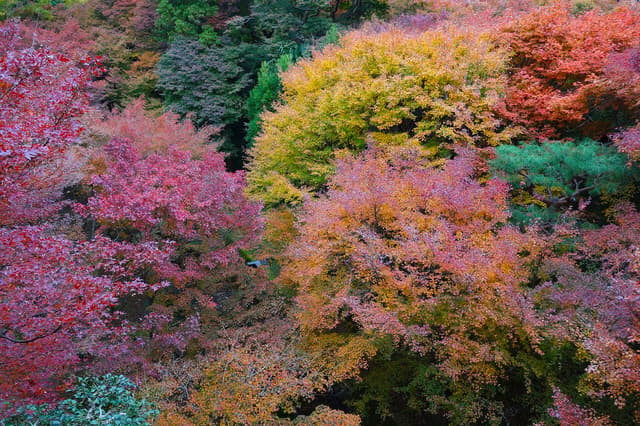
Nikko is the more dramatic of the two. The Irohazaka road climbs to Lake Chuzenji in a series of hairpin bends, and in mid-October the whole valley turns at once. Kegon Falls sits at the top with the colour around it. It feels like a mountain trip, because it is one.
The cost of that drama is the crowd. Irohazaka is a single road up and a single road down, and on an October weekend it can jam for hours. Go on a weekday if you have any choice at all, and start early rather than late.
Hakone is the more comfortable of the two. The colour is spread across the loop — Lake Ashi, the ropeway over the volcanic valley, the slopes above Gora — rather than concentrated in one valley. You see it in pieces through the day, between other things.
That suits a trip where autumn is one element rather than the entire purpose. It also means a cloudy day is less damaging, because the day was never only about the leaves.
03The practical differences that matter more than the photos
Hakone is easier to move around in. The loop is built for visitors: a train, a cable car, a ropeway and a boat that connect in sequence, all covered by one pass. Nikko is a bus ride up a mountain road and back down again.
Hakone has hot springs; Nikko has a shrine. This is the real personality difference. A Hakone day can end in an onsen, which in November is a large part of the appeal. Nikko gives you Toshogu instead — one of the most elaborate shrine complexes in Japan, and worth the trip on its own merits even without the leaves.
Nikko rewards an overnight far more. Staying up by Lake Chuzenji or at Yumoto Onsen means you see the shrines at 08:00 before the buses arrive, and it removes the Irohazaka traffic problem entirely. Hakone also rewards an overnight, but a Hakone day trip works fine; a rushed Nikko day trip is the one people regret.
04If you can only go once, and your dates are flexible
Choose Nikko if you want autumn to be the point of the day, you can travel on a weekday in the second half of October, and you are comfortable with a mountain-road crowd.
Choose Hakone if you are travelling in November, you want hot springs and Mt Fuji views alongside the colour, or you are bringing anyone who would rather not spend the day on a bus.
Both are covered in more depth in our full guides: Nikko from Tokyo and Hakone from Tokyo. If you have not fixed your dates yet, the nationwide foliage timing guide is the place to start.
05Booking notes for the autumn season
Peak-season weekends are the problem, not the destinations. Both fill with domestic travellers, and Nikko's road capacity is the harder limit of the two.
For Hakone, the Freepass is usually the right purchase — it covers the train, cable car, ropeway and boat as one, and the loop only makes sense if you are using all of them.
For Nikko, a guided day trip removes the road problem by taking the driving and the timing off your hands, which matters more here than in most places.
06Nikko or Hakone FAQ
Which is better for autumn leaves, Nikko or Hakone?
Nikko in mid to late October, Hakone in mid November. They peak a month apart, so the date decides it rather than the scenery.
Can I do both in one trip?
Yes, but only if your trip spans late October into mid November. Otherwise one of them will be green or bare.
Is Nikko too crowded in autumn?
The Irohazaka road can jam badly on October weekends. A weekday visit or an overnight stay solves most of it.
Which is better without the autumn colour?
Hakone, for the hot springs and the loop. Nikko is still worth it for Toshogu, but its strongest season is the one described here.