QUICK ANSWER
What matters first.
Kanazawa is "Kyoto without the crowds," 2.5 hours from Tokyo. The Hokuriku Shinkansen reaches it in about 2 h 30 min (~¥14,120). Two days cover the essentials: Kenrokuen — one of Japan's three great gardens (¥320) — the preserved Higashi Chaya geisha district, the Nagamachi samurai quarter, and Omicho market's seafood bowls. It slots perfectly between Tokyo and Kyoto via the Thunderbird/Shirasagi connection.
- Kanazawa is "Kyoto without the crowds," 2.5 hours from Tokyo. The Hokuriku Shinkansen reaches it in about 2 h 30 min (~¥14,120). Two days cover the essentials: Kenrokuen — one of Japan's three great gardens (¥320) — the preserved Higashi Chaya geisha district, the Nagamachi samurai quarter, and Omicho market's seafood bowls. It slots perfectly between Tokyo and Kyoto via the Thunderbird/Shirasagi connection.
- Compare Japan hotel and ryokan styles
- Learn when a regional rail pass is worth it
EDITORIAL DECISION
The choice, before the detail.
Travellers who prefer a slower city stay with a practical, walkable sequence.
You only have time for a fast station stop between larger cities.
Check current opening days and reserve any limited-entry experience before fixing the route.
Two slow days
in Kanazawa

See live departure dates and today's total before the popular slots go.
CHECK LIVE PRICECHECK TOUR PRICE · See the Shirakawa-go tour from Kanazawa ↗Reviewed 23 July 2026 · Some links are affiliate links; recommendations are chosen for relevance, not commission.
TL;DR — Kanazawa is "Kyoto without the crowds," 2.5 hours from Tokyo. The Hokuriku Shinkansen reaches it in about 2 h 30 min (~¥14,120). Two days cover the essentials: Kenrokuen — one of Japan's three great gardens (¥320) — the preserved Higashi Chaya geisha district, the Nagamachi samurai quarter, and Omicho market's seafood bowls. It slots perfectly between Tokyo and Kyoto via the Thunderbird/Shirasagi connection.
01Why go to Kanazawa?
Kanazawa kept its Edo-period districts through the war untouched, so geisha teahouses, samurai residences and a castle town survive intact — with a fraction of Kyoto's visitor numbers. Add Japan's most celebrated garden, a world-class contemporary art museum, gold-leaf everything, and arguably the country's best casual seafood. It rewards travelers on a second trip — or first-timers who want one stop off the beaten Golden Route.
02How do you get to Kanazawa?
| From | Route | Time | Cost |
|---|---|---|---|
| Tokyo | Hokuriku Shinkansen (Kagayaki) | ~2 h 30 min | ~¥14,120 |
| Kyoto/Osaka | Thunderbird + Tsuruga transfer | ~2 h 15 min / 2 h 45 min | ~¥7,700–9,400 |
| Takayama/Shirakawa-go | Highway bus | 1–2 h | ~¥2,600–4,000 |
Route tip: Tokyo → Kanazawa → Kyoto (or reverse) turns dead travel time into a destination and is covered end-to-end by the Hokuriku Arch Pass (~¥24,500) — often cheaper than a national JR Pass for this arc.
03Day 1: Gardens, castle and geisha district
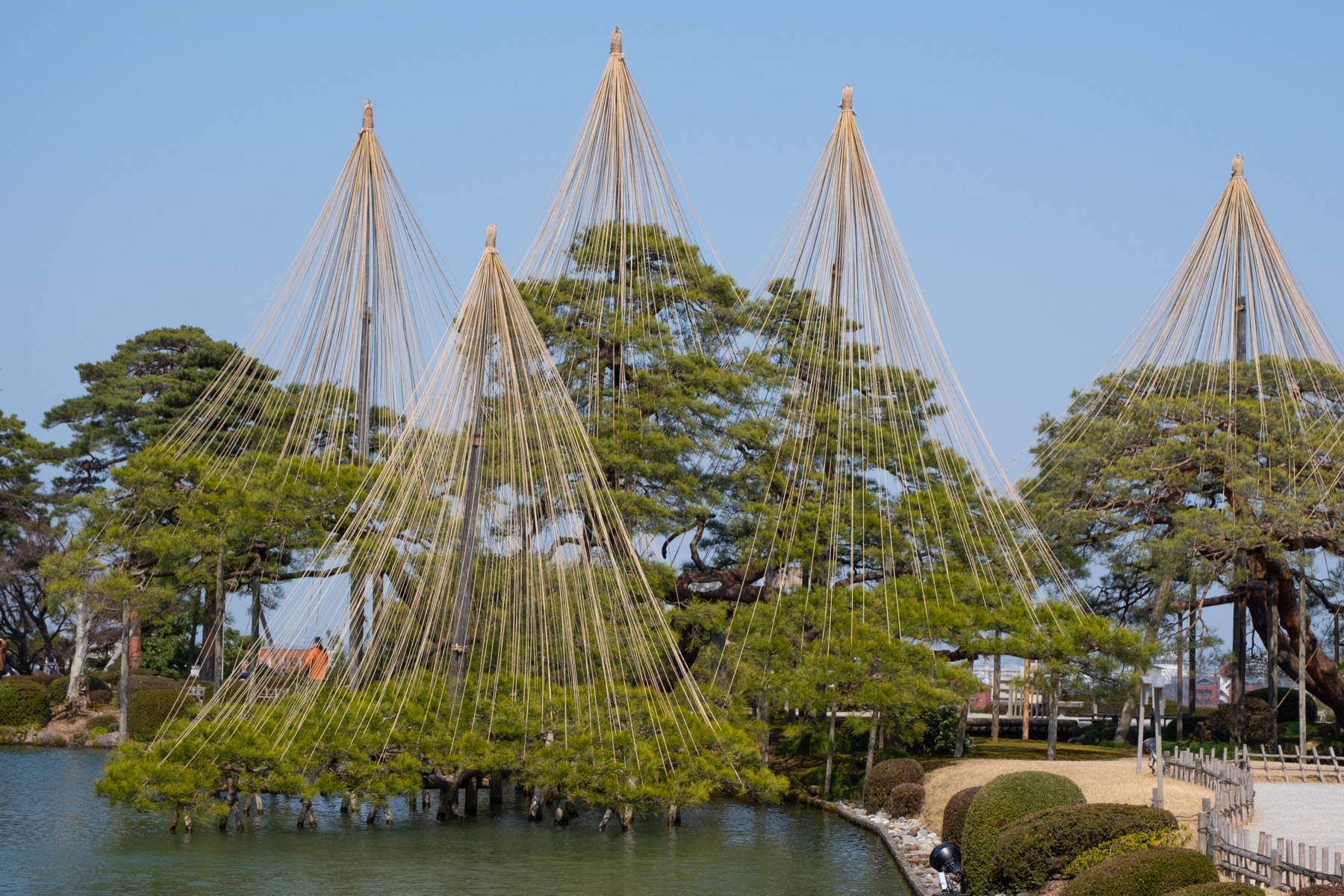
- 7:00 — Kenrokuen at opening. Entry ¥320. Early plum-blossom light, the two-legged Kotoji lantern, and near-empty paths; by 10:00 the tour groups arrive. In winter, the yukitsuri snow-ropes are the icon.
- 9:30 — Kanazawa Castle park across the bridge — reconstructed gates and lawns, free grounds.
- 11:00 — Omicho market. 300 years old and still the city's kitchen. Queue for a kaisendon seafood bowl piled with Hokuriku crab, sweet shrimp and yellowtail.
- 13:30 — Higashi Chaya district. Lattice-fronted teahouses; enter Kaikaro or Shima to see gilded interiors. Try gold-leaf soft-serve — Kanazawa produces 99% of Japan's gold leaf.
- 16:00 — Kazue-machi riverside lane at dusk, the prettiest 10-minute walk in the city.
- Evening: izakaya in the Katamachi district; local jibuni duck stew and Ishikawa sake.
04Day 2: Art, samurai and crafts
- 9:00 — 21st Century Museum of Contemporary Art. Circular, glass-walled, home of Leandro Erlich's "Swimming Pool" (paid zone; free perimeter zones). Timed tickets online in peak season.
- 11:30 — Nagamachi samurai district. Earthen walls, canals and the Nomura-ke residence's miniature garden.
- 14:00 — D.T. Suzuki Museum. A minimalist water-mirror courtyard for the philosopher of Zen — Kanazawa's quietest masterpiece.
- 15:30 — Craft time: gold-leaf application workshop, or Kutani porcelain shopping.
- Option instead of the above: half-day bus trip to Shirakawa-go's gassho-zukuri farmhouses (75 min each way).
05Where to stay
Stay between Kanazawa Station and Korinbo for walkability; choose a machiya townhouse near Higashi Chaya when atmosphere matters more than the easiest station transfer. If you are arriving late from Tokyo, staying close to the station makes the first night smoother. If Kanazawa is the slower middle stop between Tokyo and Kyoto, the old-town side usually feels more memorable.
Best next booking: narrow the hotel zone first, then decide whether this stop should be a practical station night or one atmospheric machiya or ryokan night.
06When to visit
October–November foliage and winter (December–February) snow-scapes with peak seafood (crab season opens in November) are Kanazawa's signature looks. It rains often year-round — locals joke about it — so pack the town's answer: an umbrella and no schedule.
07Kanazawa FAQ
How many days do you need in Kanazawa?
Two days cover the essential districts and the garden at a relaxed pace; a tight full day is possible if you start at Kenrokuen by 8:00. Add a third day for a Shirakawa-go side trip.
Is Kanazawa worth visiting compared to Kyoto?
They differ in scale, not quality: Kyoto has hundreds of sites, Kanazawa a dense walkable core with far fewer visitors. If Kyoto's crowds worry you, Kanazawa delivers the old-Japan atmosphere with breathing room.
How do you get around Kanazawa?
The sights form a compact arc served by the Kanazawa Loop Bus (day pass ~¥800) from the station; most district-to-district hops are also 15–25 minutes on foot. No trains needed inside the city.
Is Kenrokuen really worth it?
Yes — it is ranked among Japan's three perfect gardens for good reason, and costs only ¥320. Go at opening (7:00 in season) or for seasonal night illuminations; midday tour-bus hours are its weakest.
Can you do Kanazawa as a day trip from Tokyo?
Physically yes (2.5 hours each way), but you'd see only Kenrokuen and one district well. One night minimum — ideally en route to Kyoto so the shinkansen fare does double duty.
What food is Kanazawa famous for?
Hokuriku seafood — snow crab (November–March), sweet shrimp, yellowtail — plus jibuni duck stew, gold-leaf desserts and one of Japan's top sake regions in Ishikawa.